
Core Principles for Profitable Long-Term MMA Betting
MMA betting rewards preparation over intuition. The market is growing fast — $10.3 billion in handle for 2024 — but UK tax hikes are tightening margins. To stay ahead: treat every fight as a style-matchup problem, not a name-recognition contest. Use implied probability to identify value before you place a bet. Stake consistently with a fixed-percentage or fractional Kelly system. Factor in structural edges like cage size and corner assignment. Track closing line value, not short-term results, as your measure of progress.
Why MMA Betting Rewards the Prepared
I placed my first MMA bet in 2014 on a Fight Night prelim that most people skipped entirely. The favourite had flashy knockouts, a loud social media following, and odds so short you'd have thought the fight was already over. The underdog was a wrestle-heavy grinder with zero highlight-reel finishes. I watched the style matchup, ran the numbers, and took the dog at 3.40. He smothered the favourite for three rounds. That single bet taught me more about MMA wagering than a year of blindly backing names ever could — sportsbooks struggle to price this sport, and anyone willing to do the homework can find edges that simply don't exist in football or basketball.
Twelve years of specialising in fight data analysis have only reinforced that lesson. MMA betting is structurally different from team sports. There are no line-ups to rotate, no goalkeeper having a bad day while ten teammates compensate. Two individuals enter the cage, and the interaction between their specific skill sets determines the outcome. That complexity is what makes the sport notoriously difficult for bookmakers to handicap — and what makes it rewarding for bettors who treat it as a data problem rather than a guessing game.
The numbers back this up. MMA betting handle hit $10.3 billion in 2024, a 17% jump from the previous year. Gross gaming revenue from UFC wagering has grown at an estimated compound annual rate exceeding 18% over the past five years, outpacing nearly every other major sport. The combined MMA and boxing betting market stood at $3.2 billion in 2024 and is projected to surpass $6 billion by 2033. This is not a niche corner of the sportsbook anymore — it's one of the fastest-expanding segments in the entire industry.
MMA Betting Handle 2024
$10.3 billion (+17% year-on-year)
UFC GGR Growth
18%+ CAGR over five years
MMA + Boxing Betting Market
$3.2 billion in 2024, projected $6 billion+ by 2033
Yet most MMA betting guides recycle the same surface-level advice: "styles make fights," "manage your bankroll," "shop for the best line." They're not wrong, but they're incomplete — none integrate market data with fight analysis, UK regulatory context with practical strategy, or integrity risks with bankroll discipline. That's the gap this guide fills. I'm not selling picks. I'm explaining the system so you can build your own edge and sustain it over hundreds of bets.
Whether you're placing your first UFC wager through a UK-licensed sportsbook or sharpening an approach built over years of fight cards, this guide covers the full landscape: bet types, odds mechanics, fighter analysis, value identification, bankroll formulas, live wagering, integrity, and the UK regulatory environment that shapes every bet you place.
The MMA Betting Market in 2026
A few years ago, a bookmaker executive told me that MMA was "nice supplementary revenue" — a curiosity alongside the real earners like football and horse racing. I doubt anyone in the industry says that anymore. The global UFC market is valued at $1.74 billion in 2026, with projections pointing toward $2.79 billion by 2033 at an 8% compound annual growth rate. The UFC itself carries a valuation of roughly $23 billion, backed by a $7.7 billion media deal with Paramount signed in August 2025. These are not the numbers of a supplementary sport.
For bettors, the figure that matters most is handle — the total volume of money wagered. MMA betting handle reached $10.3 billion in 2024, climbing 17% from the prior year. The sport's gross gaming revenue has outpaced almost every other category, growing at an 18%+ compound annual rate over the past five years. Fight Matrix analyst A.J. Riot put it plainly: UFC GGR growth has been outpacing almost every other major sport in percentage terms. When handle grows at that pace, it means more liquidity in the market, sharper lines at the top sportsbooks, and — critically — more opportunities at the ones that haven't caught up.
The broader context reinforces the trend. The global sports betting market stood at $32.86 billion in 2025, growing at a projected 10.8% annually through 2034. MMA is outpacing that benchmark, which tells you where the industry's investment is heading.
UFC Valuation
$23 billion (December 2025)
MMA Betting Handle
$10.3 billion in 2024
UFC GGR CAGR
18%+ over five years
Global Sports Betting Market
$32.86 billion in 2025

For UK-based punters specifically, the landscape is shifting in ways that directly affect your bottom line. The UK generates £16.8 billion in annual gross gambling yield from remote betting alone — one of the largest regulated online markets in the world. But the cost of operating in that market just jumped. Remote Gaming Duty rose from 21% to 40% on 1 April 2026, the single largest tax increase in British gambling history. Remote Betting Duty, which applies to online sports wagers, climbs to 25% from April 2027. These increases are projected to bring in more than £1 billion annually for the Treasury.
UK Remote Gaming Duty: What Changed
These are operator-side taxes, but they ripple through to punters as tighter odds margins, reduced promotional offers, and fewer free-bet incentives. If you've noticed your favourite sportsbook trimming welcome bonuses or widening the overround on UFC markets, this is the structural reason.
What does this mean in practice? MMA is a booming market running into a tightening regulatory environment. Sportsbooks still misprice fights more often than they do in football or tennis, but margins available to UK bettors are narrowing as operators pass tax costs through. That makes skill, data, and discipline more important than ever. The casual punter backing the main event favourite is subsidising the prepared bettor who identified value three days earlier. The rest of this guide is about making sure you're on the right side of that equation.
Condition Matrix
Types of MMA Bets Every Punter Should Know
I once watched a mate bet the moneyline on a massive favourite at 1.12 odds, risking £100 to win £12. The favourite won, he celebrated, and then I showed him the method of victory market where "KO/TKO" was paying 2.10 on the same fighter — a heavyweight with a career knockout rate near 50%. Same outcome, dramatically different return. The point isn't that one bet type is universally better; it's that understanding the full menu of MMA markets lets you express the same opinion at wildly different prices.
Historically, about 44% of UFC bouts end by judges' decision, roughly 35% by knockout or TKO, and around 21% by submission. Fewer than 2% end in a draw. Those baseline percentages should sit in the back of your mind every time you open a fight card on your sportsbook app, because each bet type interacts with them differently.
Moneyline — the simplest MMA wager. You pick the winner regardless of how the fight ends. The odds reflect each fighter's implied probability of victory: a fighter priced at 1.50 decimal implies a 66.7% chance of winning. Moneyline is the foundation of UFC betting, and for most punters it's where the majority of their action sits.
Over/Under Rounds — a bet on fight duration, typically set at 1.5 or 2.5 rounds for a three-round bout. If you expect two aggressive finishers to end things early, the under becomes attractive. Nearly half of heavyweight fights end by knockout, pushing the under rate in that division far above lighter weight classes where fewer than 30% of bouts end by KO.
Method of Victory — a bet on how the fight ends: KO/TKO, submission, or decision. This market offers better prices than a straight moneyline because you're making a more specific prediction. The tradeoff is accuracy — you need to assess not just who wins but through which route.
Round Betting — the highest-risk, highest-reward standard market. You predict both the winner and the specific round in which the fight ends. Odds regularly exceed 10.00, and while the variance is brutal, a well-researched round bet on a fighter with a consistent finishing pattern can offer exceptional value.
Prop Bets — a catch-all for markets beyond the main ones: "fight to go the distance," "will there be a knockdown," specific round-and-method combinations. Prop markets are where sportsbooks most often misprice lines because the volume of bets placed is lower and the data required to set them accurately is more granular. For a deeper breakdown of every UFC market type, see the full guide to UFC betting odds explained.

Implied Probability Quick Calculation
| Fighter | Decimal Odds | Implied Probability |
|---|---|---|
| Fighter A (favourite) | 1.45 | 1 / 1.45 = 68.97% |
| Fighter B (underdog) | 2.90 | 1 / 2.90 = 34.48% |
| Combined | — | 103.45% (overround = 3.45%) |
The combined implied probability exceeds 100% because of the bookmaker's built-in margin — the overround. Stripping out that margin reveals each fighter's truer probability, which is where value identification begins.
How to Read UFC Odds in Decimal, Fractional, and American Formats
If you've ever opened an MMA betting slip and seen three different numbers for the same fight depending on which sportsbook or which settings you're using, you've encountered the format problem. It's the same information expressed in three different languages, and fluency in all three saves you from costly misreads.
Decimal odds are the standard across UK and European sportsbooks. The number represents your total return per £1 staked, including the original stake. Odds of 2.50 mean a £10 bet returns £25 (£15 profit + £10 stake). To convert decimal odds to implied probability: divide 1 by the decimal odds. So 2.50 gives you 1 / 2.50 = 0.40, or 40%.
Fractional odds remain common at traditional UK bookmakers. They show the profit relative to your stake. Odds of 3/2 mean you win £3 for every £2 staked. To convert to implied probability: denominator / (numerator + denominator). For 3/2, that's 2 / (3 + 2) = 0.40, or 40% — identical to 2.50 decimal.
American odds dominate US sportsbooks and appear frequently in UFC coverage. Positive numbers (+250) show how much you win on a $100 stake. Negative numbers (-200) show how much you must stake to win $100. The conversion to implied probability differs by sign: for negative odds, divide the absolute value by (absolute value + 100); for positive odds, divide 100 by (odds + 100).
Same Odds, Three Formats
| Format | Favourite | Underdog |
|---|---|---|
| Decimal | 1.50 | 2.75 |
| Fractional | 1/2 | 7/4 |
| American | -200 | +175 |
All three rows describe the same two fighters at the same prices. Being able to read across formats means you can compare odds from any sportsbook in the world without fumbling through conversion calculators mid-event.
If you're line shopping — and you should be — switching between formats fluently lets you compare prices across UK, European, and American books instantly. A fighter at 2.75 decimal pays more than +170 American (which equals 2.70 decimal), but you'd only spot that if you think in both systems.
Fighter Analysis: What the Data Actually Tells You
Early in my career, I lost money the same way most people do: by trusting win-loss records. A 12-2 fighter looks better than an 8-4 fighter, right? Not necessarily. Records tell you almost nothing about the quality of opposition faced, the stylistic context of each win, or the physical trajectory of the athlete. I learned to ignore the record and start with the data underneath it — striking accuracy, takedown defence, average fight time, and the specific circumstances of wins and losses. That shift turned my results around within a single quarter.
The first thing I assess in any matchup is the style interaction. MMA is not a single sport — it's a collision of disciplines, each with its own tactical grammar. A fighter's statistical profile only makes sense relative to the opponent they're facing. A striker with 65% significant striking accuracy looks dominant until you realise his next opponent has 80% takedown accuracy and averages four takedowns per fight. Numbers without context are noise; the context is always the specific matchup.
Striker Profile
High significant strike volume, low takedown attempts, keeps the fight standing. Career KO rate often above 40%. Vulnerable when pressed against the cage or taken down early.
Grappler Profile
High takedown accuracy, strong top control time, finishes by submission or ground-and-pound. Wins often come in later rounds. Vulnerable in open space against accurate counter-strikers with strong takedown defence.

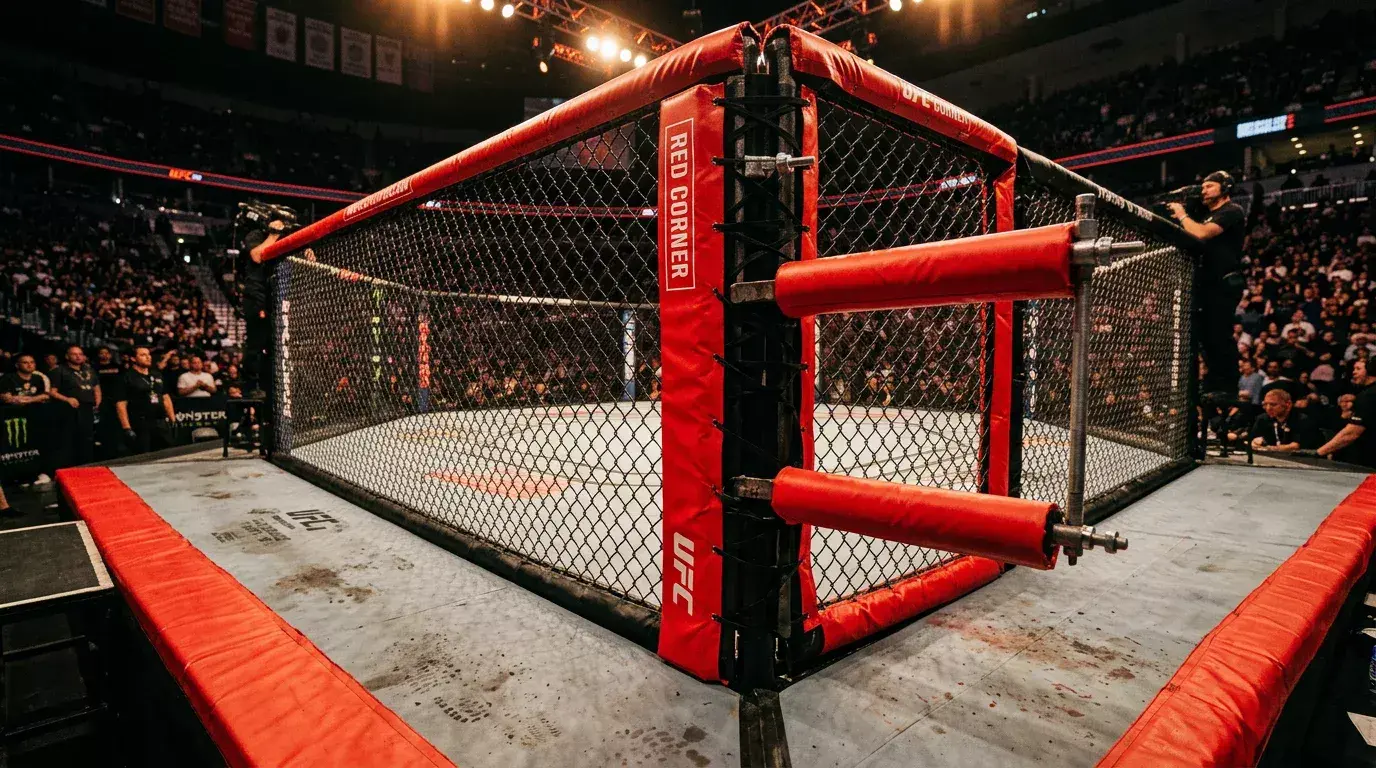
Beyond style, three structural factors consistently show up in the data. First, the red corner — typically assigned to the higher-ranked fighter or the favourite — wins between 55% and 65% of UFC bouts across all weight classes and genders. A Carnegie Mellon study analysing 6,478 UFC fights confirmed this pattern. Whether it reflects genuine psychological or procedural advantages or simply captures the fact that better fighters get the red corner is debatable, but the statistical signal is strong enough that I factor it into my models as a secondary variable.
The red corner advantage holds across every UFC weight class and both men's and women's divisions — a Carnegie Mellon study covering 6,478 bouts confirmed it as a consistent structural feature, not a statistical fluke.
Second, age gaps matter more than most bettors assume. When the age difference between two fighters exceeds five years, the younger fighter wins 61% of the time. Push that gap beyond ten years and the younger fighter's win rate climbs to 64%. Experience compensates for declining athleticism up to a point, but the data says that point arrives earlier than gut instinct suggests.
Third, the cage itself is a variable. I'll cover this in detail below, but the smaller octagon produces 12% more finishes than the standard-size cage — a factor that should adjust your over/under thinking on every Fight Night card held in a compact venue. For a full breakdown of how to weigh all these factors systematically, including reach, weight cuts, and training camp intelligence, see the dedicated guide to MMA fighter analysis for betting.
Styles Make Fights — and Shape Odds
"Styles make fights" is the most repeated phrase in MMA analysis, and most people treat it as a vague platitude. It shouldn't be. When a pressure wrestler meets a counter-striker with poor takedown defence, the style interaction creates a predictable dynamic. When two volume strikers with weak defensive wrestling meet, you're looking at a likely stand-up war with higher finish probability. These are patterns visible in the data if you know where to look.
The cage size amplifies or dampens these style interactions. The smaller UFC octagon — used at the UFC Apex and many Fight Night events — produces a 12% higher finish rate compared to the standard octagon used at numbered PPV events. A smaller cage compresses distance, making it harder for fighters who rely on footwork and range to avoid engagement. Pressure fighters and grapplers benefit disproportionately from that compression.
Cage Size Impact on Betting
The smaller UFC octagon (25 feet) shows a 12% finish-rate increase over the standard octagon (30 feet). This directly affects over/under rounds and method of victory pricing. Before placing any wager, check the venue and cage dimensions — the smaller cage favours pressure fighters and grapplers.
I track style matchups using a simple matrix: each fighter gets categorised by primary discipline (striking, wrestling, jiu-jitsu, or hybrid), preferred range (distance, clinch, ground), and pace (volume-based or counter-based). When two fighters from opposing quadrants of that matrix meet, the odds of a finish rise. When two fighters from the same quadrant meet, decisions become more likely — unless both are high-volume finishers. This framework won't replace deep film study, but it provides a structural starting point that filters out the noise from social media hype and recent results.
Finding Value in MMA Odds
The first time I truly understood value betting, I stared at a UFC card for twenty minutes, convinced I'd found a mistake. A fighter I rated at roughly 55% to win was priced at 2.40 — implying only 41.7%. That gap was the value. I took the bet, lost, and spent a month worrying my model was broken. It wasn't. Value betting is measured over hundreds of wagers, not individual outcomes. That single loss was irrelevant; similar edges returned consistent profit over the following year.
MMA creates more pricing inefficiencies than most sports, and there's a structural reason for it. As the betstamp editorial team noted, it is notoriously difficult for sportsbooks to correctly handicap MMA action, and a fighter's reputation might often exceed his true skill set or value. Fighters compete two or three times a year, change weight classes, switch camps, and evolve their skill sets between bouts. Each fight is a near-unique event, and the data available to oddsmakers is thinner than in almost any other betting market.
Value exists when a fighter's true probability of winning exceeds the implied probability in the odds. Expected Value = (Your Estimated Probability x Potential Profit) - (Probability of Losing x Stake). Positive EV means the bet has value regardless of what happens on fight night.
Identifying a Value Bet: Step by Step
Suppose you assess Fighter A at a 50% probability of winning. The sportsbook offers decimal odds of 2.30 on Fighter A.
Step 1: Calculate the implied probability from the odds. Implied probability = 1 / 2.30 = 43.5%.
Step 2: Compare your assessment to the implied probability. You rate Fighter A at 50%; the market says 43.5%. The gap is 6.5 percentage points.
Step 3: Calculate expected value per £1 staked. EV = (0.50 x £1.30) - (0.50 x £1.00) = £0.65 - £0.50 = +£0.15.
Step 4: A positive EV of £0.15 per pound staked means this bet has value. Over a large sample of similar bets, you expect to profit 15p for every pound wagered at this edge.
The hardest part isn't the maths — it's trusting the process when individual bets lose. A bet with a 50% win rate and 2.30 odds will lose half the time. Long losing streaks are not just possible but expected. The value bettor's advantage materialises over hundreds of wagers, which is why bankroll management and emotional control are inseparable from the strategy.
Hype vs Reality: The Mispricing Trap
Public money floods toward fighters with name recognition and highlight-reel knockouts, inflating the favourite's odds and creating value on the other side. When a headliner makes their UFC debut against an experienced but unglamorous opponent, the market often overprices reputation and underprices craft. I spend more time studying prelim cards than main events for exactly this reason.
Closing line value — the difference between the odds when you placed your bet and the odds at fight time — is the best long-term metric for whether your process works. If you consistently get better prices than the closing line, you're beating the market's final assessment. For a full breakdown of EV formulas, closing line tracking, and long-term profitability, the detailed MMA value betting strategy guide covers everything from spreadsheet models to realistic win-rate expectations.
Bankroll Management for MMA Bettors
I've seen sharp MMA analysts — people who genuinely pick winners at a profitable clip — go broke within six months. Not because their analysis failed, but because they sized bets like the outcome was certain. One bad card with three straight losses at aggressive stakes and the bankroll evaporated. Your edge means nothing without a system to protect it from variance.
The UK's sports betting participation rate sits at about 10% of the adult population, with 15% of men and 4% of women placing wagers. The overwhelming majority have no structured approach to stake sizing. They bet what feels right, chase losses, and treat the bankroll as disposable. For anyone trying to profit over time, that approach is financial self-sabotage.
The simplest system that works is fixed-percentage staking: risk the same percentage of your current bankroll on every bet, typically 1-3%. If your bankroll is £1,000 and you stake 2%, your first bet is £20. Lose five in a row and your bankroll drops to roughly £904, your next bet to £18.08. The system automatically reduces exposure during losing streaks and increases it during winning runs.
Kelly Criterion: A Worked Example
The Kelly Criterion calculates optimal bet size based on your estimated edge. The formula: Kelly % = (bp - q) / b, where b = decimal odds minus 1, p = your estimated win probability, q = 1 - p.
Suppose you rate a fighter at 55% to win (p = 0.55, q = 0.45) and the odds are 2.10 (b = 1.10).
Kelly % = (1.10 x 0.55 - 0.45) / 1.10 = (0.605 - 0.45) / 1.10 = 0.155 / 1.10 = 0.141, or 14.1% of bankroll.
Full Kelly is aggressive — most experienced bettors use "fractional Kelly" at one-quarter to one-half of the calculated amount. Quarter-Kelly here would be 3.5% of bankroll, a much more survivable stake for a sport as volatile as MMA.

The Kelly Criterion is mathematically elegant, but in MMA your probability estimates carry a 5-8 percentage point confidence interval — wider than football or basketball — because fighter sample sizes are tiny and variables more chaotic. Full Kelly assumes perfect calibration; quarter-Kelly absorbs that error without destroying returns. For the full formula breakdown and staking model comparisons, see the dedicated guide to bankroll management for MMA betting.
Do
- Set a fixed bankroll separate from daily finances and never top it up impulsively.
- Use a consistent staking method — fixed percentage or fractional Kelly — for every bet.
- Record every wager with your estimated probability and closing line for monthly review.
- Reduce stakes during cold streaks; percentage-based staking does this automatically.
Don't
- Double your stake after a loss to "get even" — Martingale destroys bankrolls faster than bad picks.
- Increase stakes on "sure things" — MMA has none, and certainty is usually where bias peaks.
- Bet on every fight because you're watching. Selectivity is an edge.
- Mix entertainment bets and value bets without tracking them separately.
Live Betting on UFC: Round-by-Round Opportunities
The moment a fight starts, the pre-fight market dies and a completely different game begins. I remember watching a heavy favourite get tagged clean in the first minute of a bout — nothing dangerous, but enough to make him fight cautiously for the rest of the round. The live odds swung wildly, drifting from 1.25 to past 1.60. Nothing about the fight's likely outcome had fundamentally changed, but the live market was reacting to visual drama rather than tactical reality. I took the favourite at the inflated live price, and he finished the opponent in the second round. That's the opportunity live MMA betting creates: emotional overreaction, round by round.
The UFC's partnership with Polymarket, announced in November 2025, integrates a prediction scoreboard into Paramount+ broadcasts — what TKO CEO Ari Emanuel described as transforming passive viewership into active participation. For bettors, this means more liquidity in live markets, faster odds movement, and a growing need to understand how in-play pricing works.
Live MMA odds adjust based on perceived momentum: significant strikes landed, takedowns secured, visible damage, and rounds won. The key word is "perceived." Algorithms react to what looks impactful, but experienced analysts know that not all significant strikes are equal, not all takedowns lead to meaningful control, and visible swelling doesn't always correlate with fight-ending damage. The gap between what the live market sees and what the data implies is where value lives.
Latency Is Not a Minor Detail
The window between a meaningful in-fight event and the odds adjustment can be seconds. If your sportsbook's platform lags, you're seeing prices that have already moved. Test your platform's speed on a less important card before betting live on a main event. Consistent confirmation delays mean you're operating at a structural disadvantage no analysis can overcome.
Round-by-round betting is the sharpest live strategy I use. Between rounds, there's a brief window where the sportsbook adjusts lines based on what happened in the previous round. If you disagree with the market's interpretation — if you believe the fighter who "lost" that round actually landed the more damaging shots or established a pace the opponent can't sustain — the inter-round window is your entry point. It requires fast execution and a clear thesis before the round ends, not a reactive scramble after the bell. For a complete breakdown of round-by-round tactics, momentum reads, and platform speed considerations, the UFC live betting strategy guide covers the operational side in detail.
Live betting amplifies both your edge and your risk. The speed, emotion, and volatility of in-play wagering make discipline harder to maintain — which is exactly why the integrity of the markets you're betting into matters so much.
Betting Integrity: Scandals, Safeguards, and What They Mean for You
Let me be blunt about something most MMA betting guides ignore entirely: this sport has an integrity problem, and pretending otherwise does you no favours as a bettor. I'm not saying every fight is compromised — the vast majority are legitimate — but the structural vulnerabilities in MMA are real, and understanding them is part of responsible wagering.
The most prominent recent case involved the Dulgarian versus del Valle bout in November 2025. UFC's integrity partner IC360, which monitors betting activity on every event, flagged the fight for anomalous wagering patterns. Multiple sportsbooks — including major operators — voided all wagers and returned stakes. That's the system working as designed: detection, flagging, and financial protection for bettors. But it's also a reminder that suspicious activity exists in the first place.
IC360 Monitoring: How It Works
IC360 monitors wagering on every UFC event in real time, looking for anomalous patterns — sudden line movements, unusual volume spikes, or coordinated activity across sportsbooks. When a fight is flagged, operators can suspend markets, void bets, and launch investigations. TKO President Mark Shapiro has stated that UFC hosts nearly 500 fights annually and has taken immediate action in both confirmed integrity incidents over the past three years.

Earlier in 2025, fighters Darrick Minner and Jeff Molina received multi-year suspensions for involvement in betting schemes. Molina's case was instructive: a 36-month ban for using insider information about a teammate's injury. He didn't fix a fight — he exploited non-public knowledge about a fighter's condition. That's a subtler form of manipulation, and harder for monitoring systems to catch.
Unconfirmed reports from journalist Harry Mac claimed the FBI flagged more than 100 UFC fights in 2025 for anomalous betting patterns. That number is disputed, but even a fraction of it suggests the scale of scrutiny the sport faces. Dana White has been characteristically direct, warning potential manipulators that the UFC will be their worst enemy and will pursue prosecution with the FBI.
The Fighter Pay Gap and Integrity Risk
UFC fighters receive roughly 16-20% of the organisation's revenue, compared to approximately 50% in the NBA, NFL, and NHL. Fighters on prelim cards earning a few thousand dollars face financial pressure that major-league athletes do not. Combined with access to insider information about training camp injuries, the incentive structure for manipulation — while not excusing it — becomes understandable. As one analysis noted, the structural vulnerabilities in MMA make the sport particularly susceptible because, unlike team sports, an individual fighter has complete control over the outcome.
What does this mean for you as a bettor? Three things. First, pay attention to sharp line movements in the hours before a fight — if a line moves dramatically without public news, something non-public may be driving it. Second, diversify across a card rather than concentrating your bankroll on a single bout, because voided bets disrupt your staking plan. Third, treat integrity monitoring as a positive — markets with active oversight are more reliable than unregulated ones, even if the oversight occasionally reveals uncomfortable truths.
UK Betting Landscape: Regulation, Tax, and Operator Licensing
Every bet you place on a UFC fight in the UK passes through a regulatory framework that most punters never think about — until it affects the odds they're getting or the promotions they're offered. I started paying close attention to regulation when I noticed odds tightening across the board in early 2026 on several sportsbooks I use. The explanation was straightforward: operators were pricing in the largest tax increase in British gambling history, and every punter in the country was going to feel it.
The UK Gambling Commission oversees all online sports betting through its licensing framework. Every legally operating sportsbook holds a UKGC licence, imposing requirements on fair odds, responsible gambling tools, and anti-money-laundering checks. Your deposits are ring-fenced, disputes have independent resolution, and terms can't change after you've placed a wager.
UKGC Licensing: What It Means for MMA Bettors
A UKGC-licensed sportsbook must segregate customer funds, offer self-exclusion tools, display responsible gambling messaging, and submit to regular compliance audits. If you're betting with an unlicensed operator — offshore or otherwise — none of these protections apply. For MMA betting specifically, licensed UK operators are also subject to integrity requirements that connect to systems like IC360's monitoring framework. Stick to licensed books.
The tax landscape changed dramatically on 1 April 2026. Remote Gaming Duty jumped from 21% to 40% — nearly doubling overnight. This applies to online casino and gaming products. Remote Betting Duty, which covers sports wagering including MMA, is set to rise from 15% to 25% from April 2027. Together, these increases are expected to generate more than £1 billion annually for the Treasury. The UK's gross gambling yield from remote betting already stands at £16.8 billion per year; the government clearly sees this as a revenue stream worth taxing aggressively.
Remote Gaming Duty
21% to 40% (from 1 April 2026)
Remote Betting Duty
15% to 25% (from April 2027)
Projected Annual Revenue
>£1 billion for HM Treasury
Senior analyst Adam Woodhead of The Investors Centre has highlighted how these policy moves are widening the tax differential between traditional investment and gambling products, noting that the capital gains tax annual exempt amount has fallen 76% from £12,300 to £3,000 in just two years while dividend rates are also rising. The regulatory environment is squeezing both sides.
How does this affect your MMA bets? Operators absorb these taxes partly through margin, partly through reduced promotions, and partly through tighter odds. If you've noticed fewer free-bet offers on UFC cards or wider overrounds in 2026, this is the cause. Line shopping across multiple licensed operators becomes more important when every operator independently decides how much tax burden to pass to the punter.
Responsible Gambling: Protecting Your Edge and Your Wellbeing
I've written thousands of words in this guide about finding edges, sizing bets, and exploiting inefficiencies. None of it matters if your relationship with betting becomes unhealthy. I've watched friends — intelligent, analytical people — cross from disciplined wagering into compulsive behaviour without realising it. You stop tracking results. You bet on cards you haven't researched. You chase a losing week with a reckless parlay. The analytical framework that was protecting you quietly dissolves into emotional gambling.
Among UK adults, roughly 10% participate in online sports betting — skewing heavily young and male, with 76% of the 18-24 age group using mobile phones for gambling. The accessibility that makes MMA betting convenient is the same accessibility that makes problematic behaviour easy to develop without external checks.
When to Seek Support
If you're betting more than you planned, hiding your wagering from people close to you, borrowing money to fund bets, or feeling anxious about your betting activity, these are signals worth taking seriously. The National Gambling Helpline (0808 8020 133) offers free, confidential advice. GamCare provides online chat support. GAMSTOP allows you to self-exclude from all UKGC-licensed operators for 6 months, 1 year, or 5 years. Using these tools is not a sign of weakness — it's the same discipline that good bankroll management requires, applied to your wellbeing rather than your wallet.
Do
- Set deposit limits on every sportsbook account — most UK-licensed operators make this easy.
- Schedule regular breaks from betting, especially after a losing streak.
- Track time spent on betting research separately — if it crowds out other activities, recalibrate.
- Use GAMSTOP or operator-level self-exclusion proactively, before you feel you "need" it.
Don't
- Treat losses as debts that must be recovered through more betting.
- Use betting as a primary source of excitement or emotional regulation.
- Dismiss early warning signs because your overall results are still profitable — compulsive behaviour and positive ROI can coexist temporarily.
- Bet on UFC events while intoxicated or emotionally charged.
A sharp bettor knows when to walk away from a bad line. Apply the same logic to the activity itself. If betting stops being a disciplined, enjoyable application of your analytical skills and starts feeling like an obligation or an escape, that's your signal to step back.
Your Pre-Bet Checklist
Before I place any MMA wager, I run through the same checklist. It takes five minutes and has saved me from more impulsive bets than I can count. It doesn't guarantee a win, but it ensures every bet is a deliberate decision backed by a consistent process.
Eight Steps Before You Place an MMA Bet
- Confirm the fight is still on — check for late pull-outs, weight misses, or injury replacements within the last 48 hours.
- Review both fighters' style profiles and recent form, focusing on the specific matchup interaction rather than overall records.
- Check the venue and cage size — a smaller octagon shifts the expected finish rate upward by 12%, which affects over/under and method of victory markets.
- Calculate the implied probability from the current odds and compare it to your own probability estimate. If the gap is less than 3-4 percentage points, the value is marginal and the bet may not justify the variance.
- Line-shop across at least three UK-licensed sportsbooks. Even small differences in decimal odds compound over dozens of bets per year.
- Determine your stake using your bankroll system — fixed percentage or fractional Kelly — not the size of the potential payout or the strength of your conviction.
- Record the bet details: fighter, odds taken, stake, your estimated probability, and the reasoning behind the wager. This log is your performance review at the end of every quarter.
- Check yourself. Are you betting because the analysis supports it, or because you want action? If the honest answer is the latter, close the app and revisit the card tomorrow.
This checklist might seem rigid, but rigidity is the point. MMA is a chaotic, emotional sport — the discipline comes from your process, not the moment. Every profitable bettor I know has some version of this routine. The specifics vary; the principle is universal: never let a bet reach your sportsbook account without passing through a structured filter.
Frequently Asked Questions
How do you read MMA betting odds in decimal and fractional
formats?
Decimal odds show total return per unit staked — 2.50 means a £10 bet returns £25. Implied probability: 1 / 2.50 = 40%. Fractional odds show profit relative to stake — 3/2 means £3 profit per £2 wagered. To convert: denominator / (numerator + denominator), so 2 / 5 = 40%. Most UK sportsbooks let you switch formats in settings.
What are the most common types of MMA bets?
The five core markets are moneyline (picking the winner), over/under rounds (fight duration), method of victory (KO/TKO, submission, or decision), round betting (specific round and winner), and prop bets (speciality markets). Moneyline carries the highest volume, but method of victory and round betting often offer better value because lower casual volume creates pricing inefficiencies.
Is MMA betting profitable in the long run?
For disciplined bettors who identify genuine edges and manage bankroll rigorously, yes. MMA's structural complexity creates more pricing inefficiencies than major team sports. A realistic expectation is low single-digit ROI over hundreds of wagers. Tracking closing line value — whether you consistently beat the market's final price — is the best early indicator of real edge.
How do fighting styles affect UFC betting outcomes?
Style matchups are the most important analytical input. A dominant wrestler facing a striker with poor takedown defence creates a predictable dynamic that shifts probabilities away from headline stats. Two aggressive finishers in a smaller cage produce higher finish rates than counter-strikers in a full-size octagon. Analyse the interaction between two specific skill sets rather than evaluating either fighter in isolation.
What is the best bankroll strategy for MMA wagering?
Fixed-percentage staking — risking 1-3% of your current bankroll per bet — is the simplest effective system. It scales exposure down during losing streaks and up during winning runs automatically. For experienced bettors, fractional Kelly optimises stake size based on estimated edge but demands accurate probability estimates.
How does live betting work during a UFC fight?
In-play odds adjust based on significant strikes, takedowns, visible damage, and rounds won. Odds shift most after knockdowns, submission attempts, and between rounds. The main challenges are latency, emotional decision-making, and processing fight information faster than the algorithm. Successful live betting requires a pre-formed thesis, not reactive scrambling.
Are UFC fights ever fixed, and how is betting integrity
monitored?
Confirmed fight-fixing is extremely rare, but integrity violations involving insider information have occurred. Fighters Darrick Minner and Jeff Molina received multi-year bans in 2025, and IC360 — the UFC's integrity partner — flagged the Dulgarian versus del Valle bout for anomalous wagering. IC360 monitors every UFC event in real time. Watch for unexplained line movements and treat integrity monitoring as a protective feature of regulated markets.